Why Governance Needs a Rethink
2026 isn’t just another year—it’s the era of Agentic AI and Low-Code at scale. Governance can’t be about locking things down anymore; it’s about enabling safe innovation. In my experience as a Power Platform Super User and Enterprise Architect, the organizations that thrive are those that transition from reactive firefighting to a proactive, Zoned Governance framework.
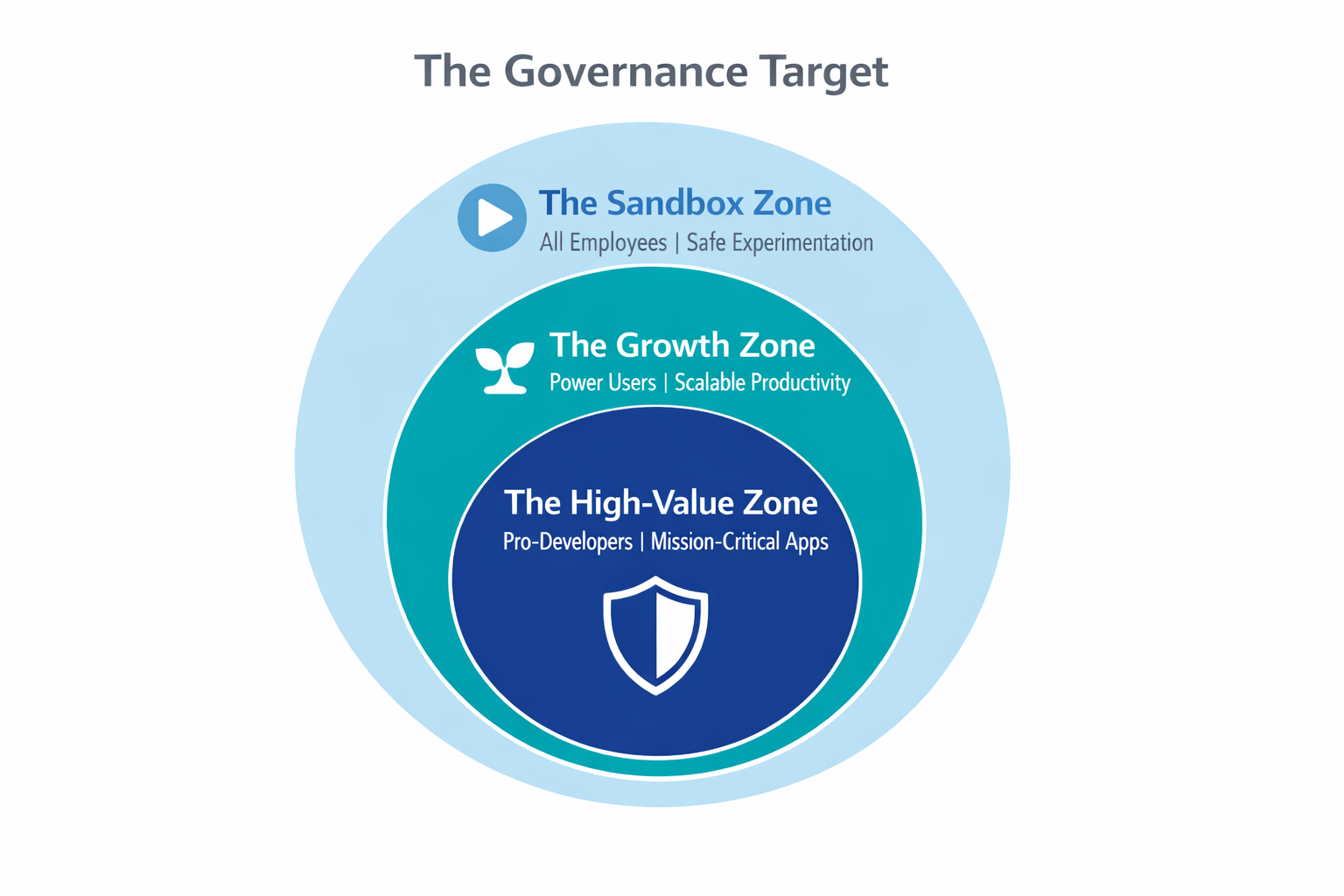 Figure 1: The Sunil Kumar Pashikanti - Zoned Governance Framework. This original architectural model demonstrates the transition from restrictive administrative control to a tiered security posture, enabling enterprise-scale innovation while maintaining rigorous data guardrails through Managed Environments and Granular DLP.
1. Environment Strategy: The Tiered Taxonomy
A healthy platform starts with a clear environment taxonomy. I recommend an architecture that categorizes environments by risk and impact:
- Personal Productivity (Sandbox): Highly restricted DLP, minimal connectors—a safe space for experimentation.
- Departmental Solutions (Growth Zone): Shared environments utilizing Managed ALM pipelines to ensure code quality.
- Enterprise-Critical (High-Value Zone): Fully Managed Environments with dedicated capacity and the highest security posture.
2. Advanced DLP: Granular Control in 2026
Modern architecture requires moving beyond the basic “Business vs Non-Business” split. To protect enterprise data in the age of AI, I advocate for:
- Connector Action Control: Restricting specific actions within a connector (e.g., allowing
Readbut blockingDeletein SQL). - Endpoint Filtering: Limiting connectors to communicate only with verified, pre-approved enterprise endpoints.
3. CoE: Transitioning to Automated Compliance
The Center of Excellence (CoE) Starter Kit is the gold standard for visibility, but it must be extended. True leadership in this space involves Automated Governance:
Architect’s Governance Model: Use Power Automate to trigger a Business Justification Flow whenever a new production asset is created. This allows for real-time capture of ROI and data sensitivity, ensuring compliance at the point of creation.
Conclusion: Governance as a Strategic Enabler
Governance should accelerate innovation, not block it. By adopting a Zoned Governance approach and leveraging Managed Environments, architects can empower makers while maintaining the rigorous security standards required by global enterprises.
Let’s Connect
How is your organization handling the shift to Managed Environments in 2026? I would love to hear your thoughts in the Power Platform Community or on LinkedIn.

Sunil Kumar Pashikanti
Principal Software Architect & Microsoft Community Super User. With 18+ years in the Microsoft ecosystem, I specialize in bridging the gap between enterprise business needs and advanced technical execution across Power Platform and Azure.