🎯 The Problem
Power Automate enables rapid workflow creation, but it lacks a standardized approach for:
- Error handling
- Failure propagation
- Observability
- Cross-flow traceability
As solutions scale, this leads to hidden failures and operational blind spots.
🧱 The Missing Layer
Enterprise systems typically separate:
- Execution
- Logging
- Monitoring
- Alerting
In Power Automate, these concerns are often mixed or inconsistently implemented.
🛡️ Introducing FlowArmor
FlowArmor is a lightweight framework designed to standardize:
- Error handling
- Telemetry generation
- Correlation tracking
- Failure propagation
🧭 Architectural Pattern
FlowArmor enforces a structured execution model:
TRY → CATCH → FINALLY → Outcome Decision
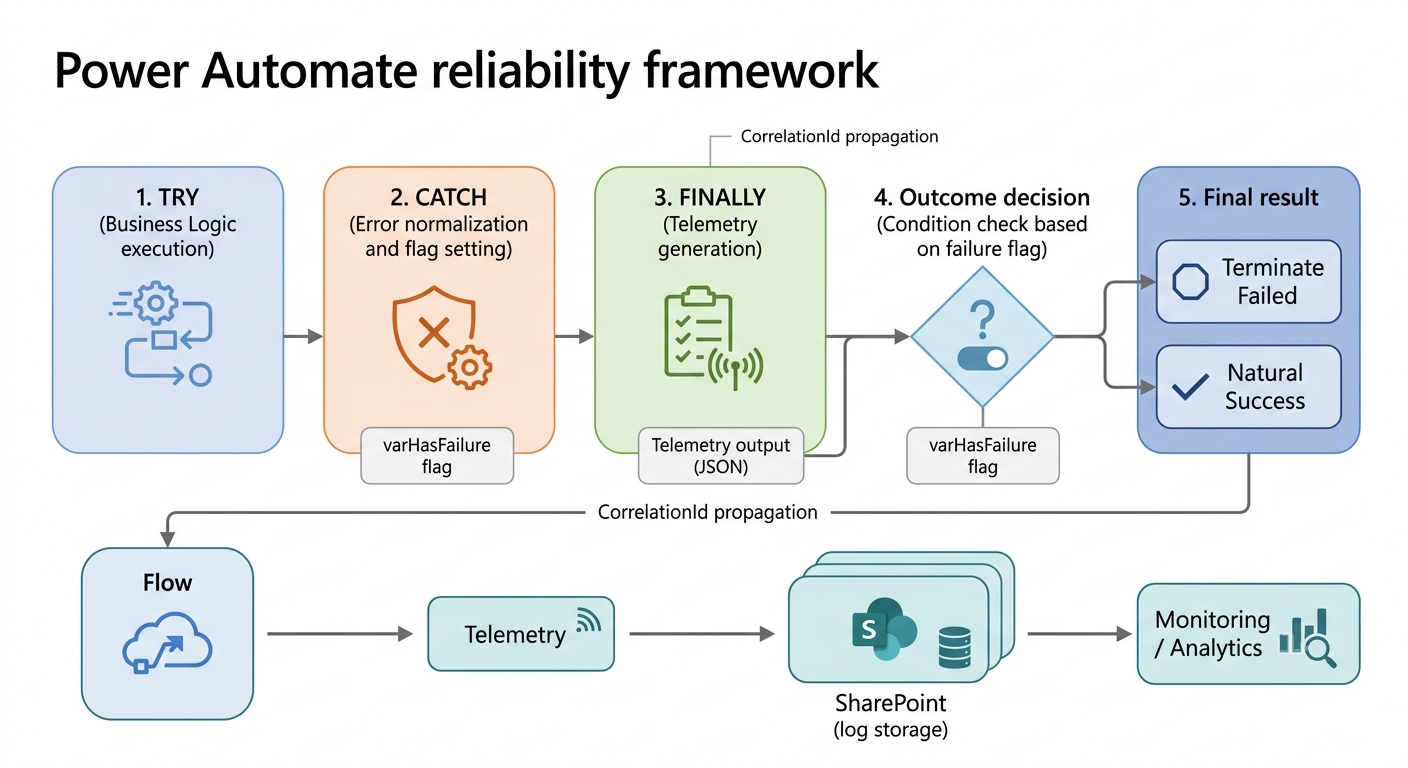
Execution Behavior
- TRY executes business logic
- CATCH normalizes error
- FINALLY emits telemetry
- Outcome is explicitly determined
🔑 Key Architectural Principles
Separation of Concerns
- Flow → generates telemetry
- External systems → consume telemetry
Failure Propagation
Flows explicitly fail when needed, avoiding silent success states.
Standardized Telemetry
A consistent schema ensures predictable debugging and future extensibility.
Extensibility
Storage and monitoring systems can evolve independently:
- SharePoint (v1)
- Dataverse (future)
- Application Insights (enterprise)
🔗 Correlation & Traceability
Each execution is assigned a CorrelationId.
In the current model:
- One log entry per execution
- CorrelationId helps identify and link execution context
In future implementations:
- Multiple entries can share the same CorrelationId
- Enabling full execution path tracing
📊 Observability Maturity Model
| Tier | Description |
|---|---|
| Tier 1 | Centralized logging (SharePoint) |
| Tier 2 | Event-driven monitoring flows |
| Tier 3 | Full observability (Azure Monitor, App Insights) |
💡 Key Insight
FlowArmor does not aim to replace monitoring systems.
Instead, it acts as the missing layer:
Standardizing how workflows emit telemetry
🚀 Outcome
FlowArmor transforms Power Automate flows from:
- Black-box executions ❌
to:
- Observable systems ✅
📊 Before vs After FlowArmor
| Aspect | Without FlowArmor | With FlowArmor |
|---|---|---|
| Failure Visibility | Hidden | Explicit |
| Error Handling | Inconsistent | Standardized |
| Debugging | Manual | Structured |
| Observability | Limited | Scalable |
For a practical walkthrough and implementation overview, read the technical guide:
Flowarmor-Power Automate Reliability Framework
🏁 Conclusion
Reliability is not just about handling errors — it is about making systems observable and predictable.
FlowArmor provides a simple, scalable pattern to bring consistency, visibility, and control to Power Automate workflows.
It represents a shift from building flows that merely run to building flows that can be observed, trusted, and debugged at scale.
In modern automation systems, observability is not optional, it is a fundamental design requirement.
🔗 Get the Component
You can find the source code, documentation, and solution packages on my GitHub:

Community Contribution: If you are a Power Platform developer or architect dealing with hidden failures, inconsistent error handling, or limited observability, I encourage you to try FlowArmor and share your feedback. Let’s build more reliable, traceable, and production-ready automation solutions together.
Found this helpful? I’d appreciate it if you could share this with your team or mark this as a helpful resource in the Power Platform community!
Let’s Connect
How is your organization handling the shift to Managed Environments in 2026? I would love to hear your thoughts in the Power Platform Community or on LinkedIn.

Sunil Kumar Pashikanti
Principal Software Architect & Microsoft Community Super User. With 18+ years in the Microsoft ecosystem, I specialize in bridging the gap between enterprise business needs and advanced technical execution across Power Platform and Azure.