In the rapidly evolving landscape of the Model Context Protocol (MCP), it is easy to assume that if two platforms claim support for the same protocol, they should just work together. In practice, many developers are discovering otherwise when attempting to connect Microsoft Copilot Studio directly to GitHub’s hosted MCP endpoint.
This particularly affects architects attempting to reuse GitHub‑hosted MCP tooling from Copilot Studio custom actions.
Despite supplying a valid Personal Access Token (PAT) and correct headers, the integration fails with a deceptively simple error:
Content-Type must be 'application/json'
This is not a configuration mistake. It is a protocol paradox rooted in the March 2026 transport updates.
Architectural Note: This analysis reflects platform behavior following the March 2026 (v2026-03-26) update to the MCP spec, which introduced Streamable HTTP.
The Architectural Mismatch: Language vs. Transport
The root cause lies in the transport layer. While both systems speak MCP at the protocol level, the 2026 specification allows for different transport bindings. Copilot Studio and GitHub have optimized for different compliant variants:
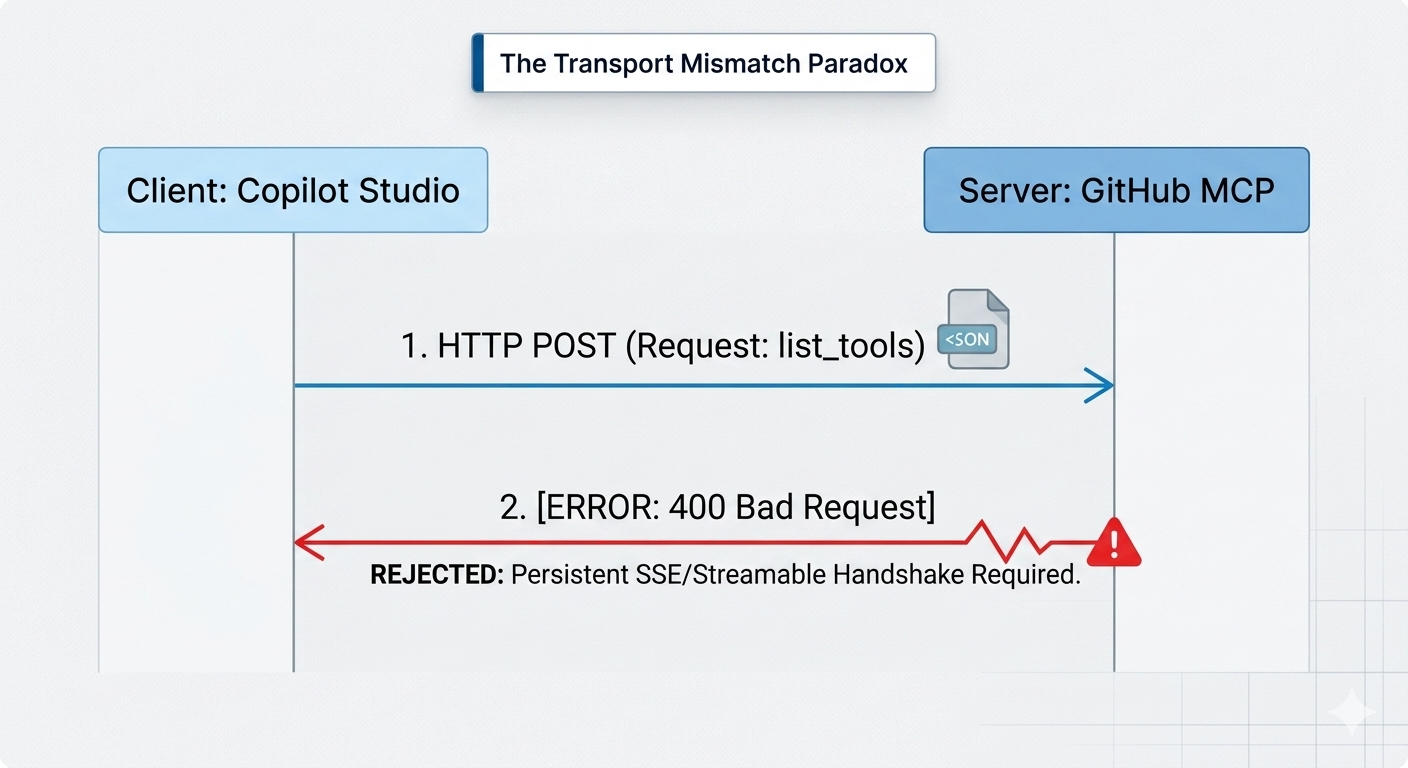
- Copilot Studio has aligned with MCP’s Stateless Streamable HTTP binding.
- GitHub Hosted MCP remains on the Stateful SSE (Server-Sent Events) transport optimized for IDE persistence.
A useful analogy is language versus telephone networks: the language (English/MCP) is shared, but one side is using a traditional landline (Persistent SSE) while the other is using a walkie-talkie (Stateless Streamable REST).
Transport Implementations Compared
| Feature | Copilot Studio (Consumer) | GitHub MCP (Provider) |
|---|---|---|
| MCP Version | v2026-03-26 (Streamable) | v2024.11 (Legacy SSE) |
| Communication Style | Request/Response (Stateless) | Streaming/SSE (Persistent) |
| Connection Model | Standard HTTP POST | Stateful Handshake/Session |
| Data Flow | Synchronous JSON | Asynchronous Event Stream |
Both transports are MCP-compliant, but optimized for fundamentally different execution environments.
1. Copilot Studio: The Stateless REST-Style Client
Copilot Studio’s MCP connector treats MCP servers as stateless resources. It sends a single POST request and expects a synchronous response. This aligns with low-code execution environments that prioritize predictable, short-lived compute cycles.
2. GitHub MCP: The Stateful IDE Endpoint
GitHub’s hosted MCP endpoint (https://api.githubcopilot.com/mcp/) is designed for IDE-based agents (VS Code, Cursor). These require long-lived connections to handle complex, multi-step tool use. It rejects one-off POST calls that do not initiate the proper session framing required for SSE.
The “Red Herring” Content-Type Error
When Copilot Studio sends a standard POST to GitHub, GitHub’s gateway identifies a protocol it does not intend to service via stateless REST. It responds with a generic error referencing Content-Type.
This is misleading. The headers are fine; the communication model is not. Copilot Studio is looking for a standard JSON response, but the server is trying to initiate an event stream. This is a textbook example of a transport-level incompatibility masquerading as a configuration issue.
Integration Patterns: The Path Forward
Because we cannot change the internal transport logic of these SaaS platforms, we must apply the Adapter Pattern.
The Bridge Approach (The “Middle-Man”)
Introduce a mediator—such as an Azure Function—that acts as a protocol translator. This bridge handles the stateful handshake with GitHub so Copilot Studio doesn’t have to.
The Flattening Contract (What the Bridge Actually Returns)
At the heart of this architecture is an explicit flattening contract.
The Bridge does not forward MCP streaming semantics upstream. Instead, it collapses a stateful, multi-message interaction into a single, deterministic JSON payload that Copilot Studio can reason over reliably.
Conceptually, the Bridge performs four steps:
- Initiates and maintains the SSE session with the MCP server
- Collects streamed messages, tool calls, and intermediate state
- Resolves completion or failure
- Emits a flattened response shaped for Copilot Studio actions
A representative response might look like this:
{
  "status": "completed",
  "summary": "3 issues found matching search criteria.",
  "data": {
    "issues": [
      { "id": "BUG-1024", "title": "Authentication timeout", "priority": "High" },
      { "id": "BUG-1027", "title": "UI regression in settings", "priority": "Medium" }
    ]
  },
  "toolCalls": [
    { "name": "searchIssues", "durationMs": 412 }
  ],
  "errors": []
}
The exact schema is intentionally domain-specific, but the structural guarantees are consistent.
| Feature | Requirement |
|---|---|
| Request Model | One request → one response |
| Data Integrity | Fully materialized state |
| Transport | No streaming |
| Logic Flow | No continuation required |
Architectural Insight
This is not a limitation of MCP—it is a deliberate translation boundary optimized for Copilot Studio’s execution model. By absorbing the complexity of stateful streams within the Bridge, you provide the orchestrator with the deterministic, structured data it requires to function reliably.
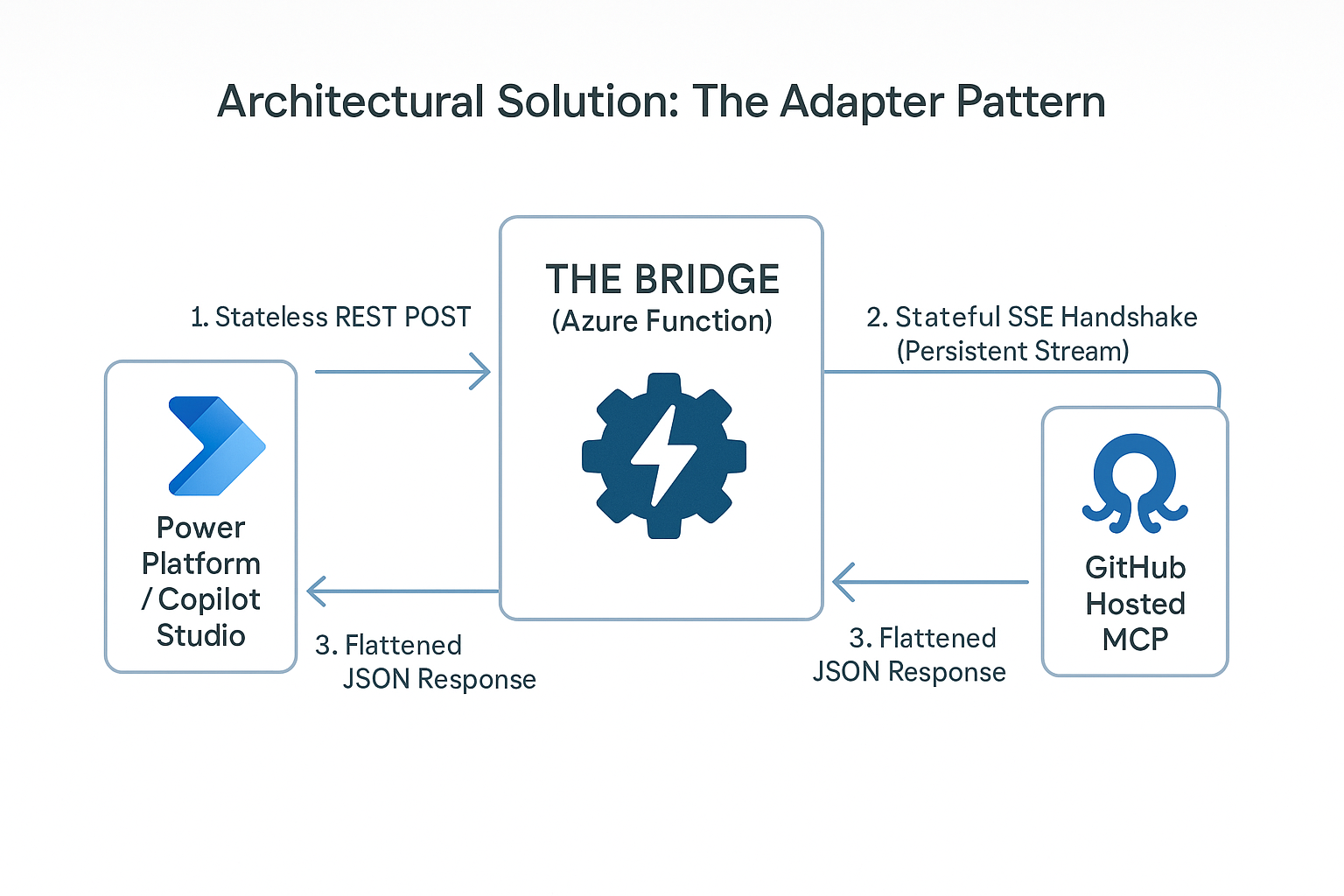
- Ingress: Receives the stateless
POSTfrom Copilot Studio. - Translation: Establishes the persistent SSE connection with GitHub’s MCP.
- Aggregation: Collects the JSON‑RPC messages from the stream and returns a single, flattened JSON object.
A Practical Alternative: Native REST
If your objective is repository management or issue tracking, the most efficient path is often to avoid MCP entirely in favor of:
- The out-of-the-box GitHub connector for Power Platform.
- A Custom Connector pointing directly to the GitHub REST or GraphQL APIs.
Design Takeaway: When Naming Outpaces Standards
This scenario highlights an important architectural lesson: Shared acronyms do not guarantee shared implementations. MCP is a powerful protocol, but its flexibility is its complexity. When designing systems around emerging AI standards:
- Validate the Transport Layer, not just the protocol name.
- Watch for “Flavor” mismatches between stateless low-code platforms and stateful IDE-first services.
- Standardize on the Adapter Pattern early to avoid “debugging the un-debuggable.”
Understanding why the failure occurs allows us to move past futile header troubleshooting and toward durable, well-aligned architectures.
Why Copilot Studio Forces This Pattern
This architecture exists because Copilot Studio operates under constraints that fundamentally differ from MCP’s design assumptions.
Key realities to account for:
Stateless execution model
Custom actions are evaluated as independent calls. There is no concept of session affinity or conversational transport continuity.No Server-Sent Events (SSE) support
Copilot Studio expects a complete HTTP response. Streaming protocols are not consumable within action execution.Strict timeout expectations
Actions must complete within bounded execution windows. Long-lived or interactive exchanges are not viable.JSON-first reasoning model
The orchestration layer is optimized for structured outputs, not incremental tokens or partial state.
Attempting to expose MCP directly to Copilot Studio violates these assumptions and leads to brittle or non-deterministic behavior.
The Bridge exists not to “simplify” MCP—but to respect Copilot Studio’s contract while still leveraging MCP’s strengths downstream.
From Adapter to Control Plane: The Multi-Agent Future
While this pattern starts as a protocol adapter, it does not end there.
Once introduced, the Bridge naturally evolves into a coordination layer:
- One Bridge can front multiple MCP servers
- Different MCP providers can be selected per intent
- Results can be normalized, ranked, or fused before returning to Copilot Studio
- Policy, throttling, and observability can live at the boundary
In a multi-agent architecture, the Bridge becomes more than glue—it becomes the translation and governance surface between agents, tools, and models.
Copilot Studio remains the orchestrator. MCP servers remain specialists. The Bridge becomes the place where:
- protocols are reconciled,
- contracts are enforced,
- and complexity is deliberately absorbed.
What begins as an adapter becomes, over time, a control plane for agent interoperability.
For example, a Copilot Studio agent could route read‑only queries to GitHub MCP while delegating workflow execution to an internal enterprise MCP server, without needing to understand either protocol’s transport semantics.
Found this helpful? I’d appreciate it if you could share this with your team or mark this as a helpful resource in the Power Platform community!
Let’s Connect
How is your organization handling the shift to Managed Environments in 2026? I would love to hear your thoughts in the Power Platform Community or on LinkedIn.

Sunil Kumar Pashikanti
Principal Software Architect & Microsoft Community Super User. With 18+ years in the Microsoft ecosystem, I specialize in bridging the gap between enterprise business needs and advanced technical execution across Power Platform and Azure.